
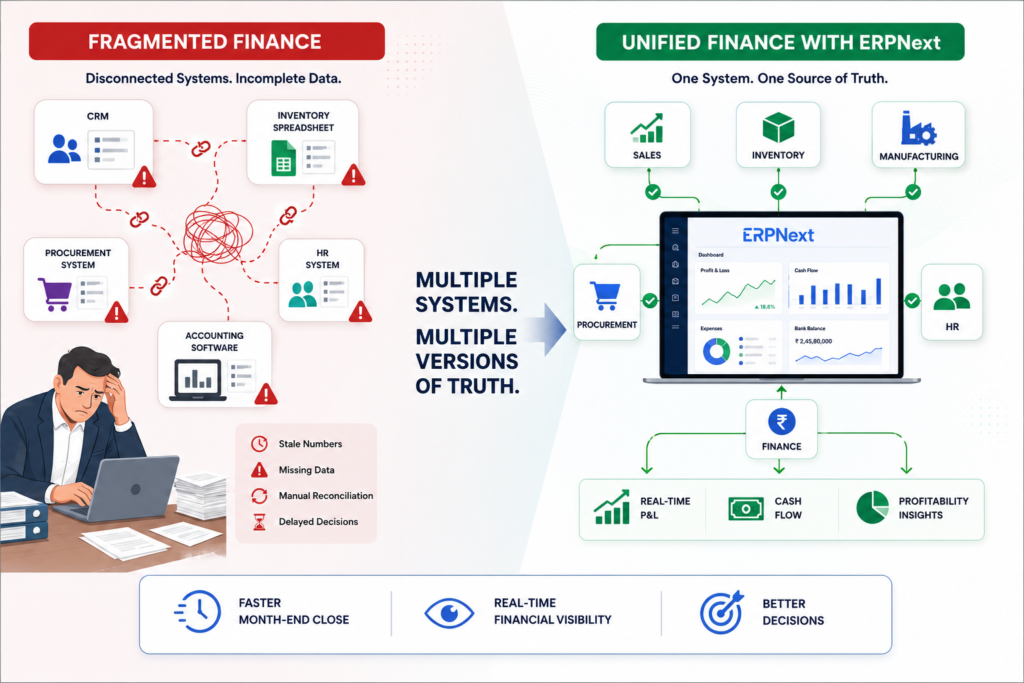
For growing enterprises, financial visibility is often a casualty of rapid scaling. It usually starts with a familiar pattern: your sales team logs deals in a standalone CRM, the warehouse tracks inventory on spreadsheets, and your accounting team manually copies that data into separate software like Tally, QuickBooks, or Xero.
As a CFO or finance director, this fragmentation means you are constantly dealing with stale numbers, missing data, and painful month-end reconciliations.
When fast-growing businesses look to build a single source of financial truth, ERPNext Accounting software stands out as an enterprise-grade solution. Unlike standalone bookkeeping apps that merely record historical data, ERPNext natively ties your operational workflows—production, inventory, procurement, and HR—directly into an immutable general ledger.
Download the ERPNext Brochure
See how SKIL Global helps manufacturing and pharma plants plan, implement, and sustain ERPNext.
Let’s dive into the core financial problems ERPNext solves and how it eliminates operational bottlenecks for modern finance teams.
1. Native Statutory Localization & Tax Compliance
Manual tax computation is a major compliance risk. Financial teams spend hours matching transaction data with local tax matrices.
- The ERPNext Difference: ERPNext includes robust, regional tax compliance modules built right into its core. For instance, in the South Asian market, it natively automates complex GST configurations, auto-fetches customer/vendor GSTIN data, pre-loads over 14,000 HSN/SAC codes, and generates portal-ready GSTR-1, GSTR-2, and GSTR-3B JSON uploads. It handles automatic Tax Deducted at Source (TDS) capping and calculations out of the box. For international markets like the UK or UAE, it manages localized VAT frameworks seamlessly.
2. Advanced Ledger Architecture Without Chart of Accounts Clutter
Traditional accounting software forces you to create hundreds of duplicate sub-ledgers just to track profitability by location, department, or marketing campaign. This leaves you with a chaotic, unmanageable Chart of Accounts (COA).
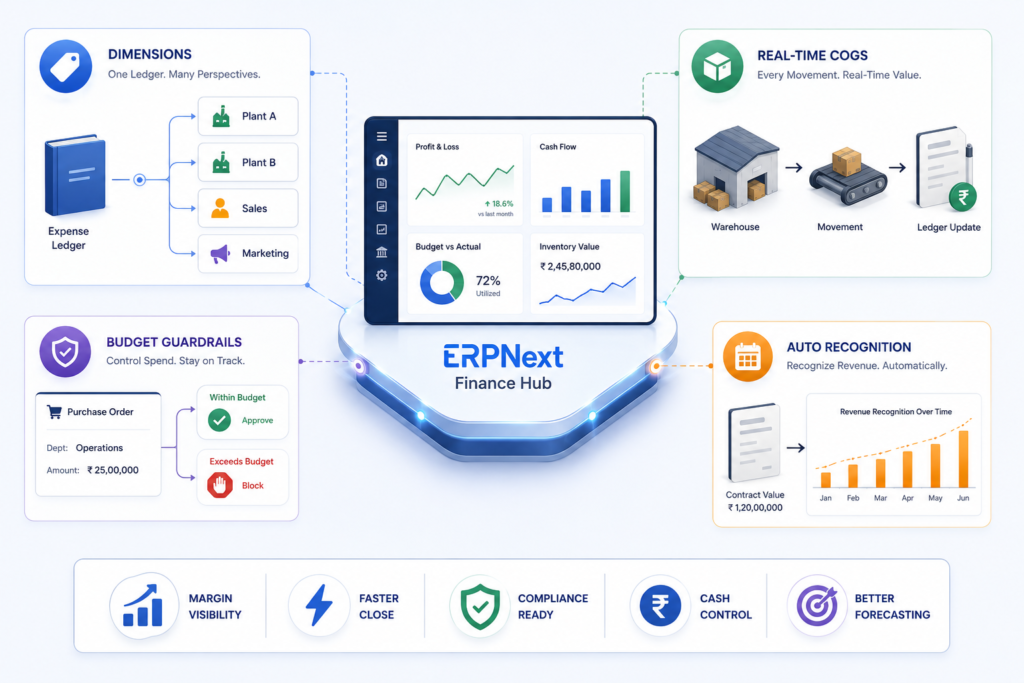
- The ERPNext Difference: ERPNext solves this cleanly through Accounting Dimensions and Cost Centers. You maintain a streamlined, logical Chart of Accounts tree. When a transaction occurs, accountants simply tag it with customizable dimensions (e.g., Branch, Department, Project, or Sales Channel). ERPNext then automatically generates granular Profit and Loss (P&L) statements and balance sheets by dimension, keeping your core finance sheets perfectly structured.
3. Real-Time Inventory Valuation and True COGS Precision
If your inventory software doesn’t natively communicate with your accounting software, your Cost of Goods Sold (COGS) figures are essentially guesswork until your physical month-end audit.
- The ERPNext Difference: ERPNext runs on a rigid, automated perpetual inventory system. Every time raw materials are received, moved to a work-in-progress (WIP) warehouse, or shipped out as finished goods, the system posts real-time journal entries to the ledger. Furthermore, it supports Landed Cost Vouchers, allowing you to allocate external costs (like freight, customs duties, and handling fees) directly back into item valuations. This ensures your final gross margins are hyper-accurate.
4. Proactive Budgetary Controls & Revenue Recognition
Most accounting software only shows you that a department blew past its budget after the cash has left the bank account.
- The ERPNext Difference: ERPNext empowers corporate finance teams with proactive budget allocation control. You can set monthly or annual budget splits against specific Cost Centers or Projects and configure the system to warn or completely block managers from raising Purchase Orders if they exceed their threshold. For subscription or contract-based models, its built-in Deferred Revenue and Deferred Expense schedules automatically automate monthly revenue recognition entries on autopilot.
The Strategic Verdict: Move Beyond Fragmented Data
Standalone accounting tools are built to look backward at what you already spent. A unified platform like ERPNext is built to look forward, helping you optimize cash flow in real time.
At Skil Global, we don’t just set up software; we build robust financial control systems. By eliminating manual data entry between platforms and establishing strict data governance via the Frappe framework, we help you eliminate cash leakages, automate tax reporting, and unlock clear visibility into your true operational profitability.
Ready to transform your corporate financial operations and build an airtight, compliance-ready accounting ecosystem? Schedule a financial discovery session with the Skil Global team today.
Frequently Asked Questions
ERPNext features an Opening Invoice Creation Tool and structured data migration pipelines. You can cleanly migrate your historical Chart of Accounts, vendor/customer masters, outstanding opening balances, and asset registries into the system. If transitioning mid-fiscal year, the system handles asset depreciation and open invoices smoothly to keep your historical audits perfectly aligned.
Yes. ERPNext allows you to bulk-upload bank statements (via standard CSV/Excel formats) or connect directly to live transactional banking feeds. Its reconciliation engine automatically matches transactions based on values, dates, and references, allowing accountants to clear outstanding accounts receivable and payable in just a few clicks.
ERPNext features a built-in Fixed Asset Management module. When a capital expense is logged, it automatically builds an asset record complete with localized depreciation schedules. It supports globally accepted valuation methods—including Straight Line, Written Down Value (WDV), and Double Declining Balance—and posts monthly depreciation journal logs automatically to the general ledger.