
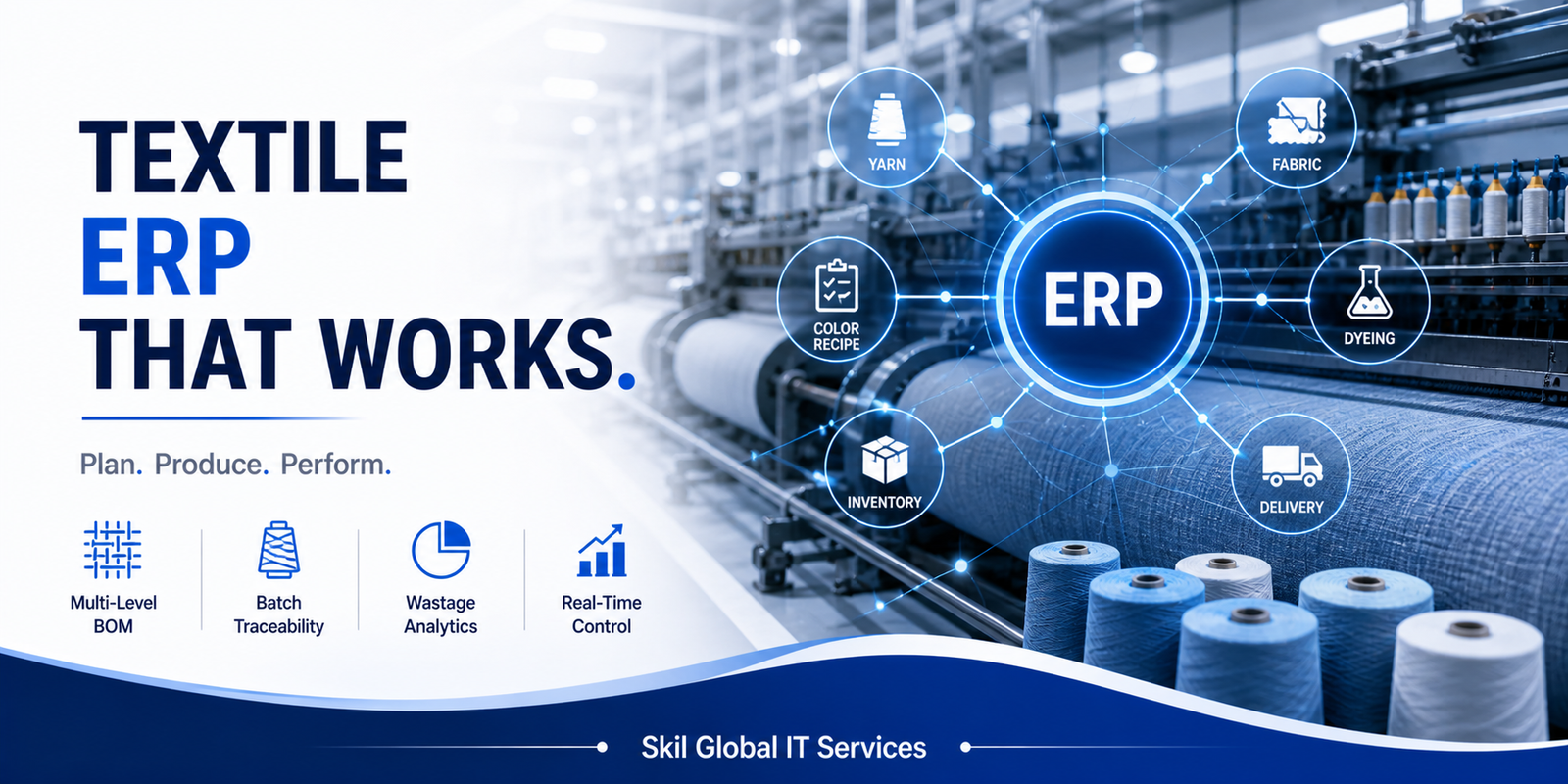
The textile landscape in 2026 is no longer just about looms and spindles; it is about data velocity. With rising global demand for sustainable fashion and ultra-fast lead times, manufacturers are realizing that spreadsheets are a liability.
To stay competitive, your ERP cannot just be an “accounting tool.” It must be a control system that manages the unique complexities of fiber mixing, yarn counts, and multi-stage dyeing.
Why Generic ERPs Fail the Textile Test
Most standard ERPs treat inventory as simple “units.” In textiles, “one unit” of fabric could be 500 meters of greige with a 2% shrinkage allowance or 480 meters of dyed twill with a specific GSM.
A Textile-specific ERP must handle:
- Multi-Level BOMs: Managing style-color-size combinations without creating a million individual SKU entries.
- Wastage Analytics: Distinguishing between hard waste (unusable) and soft waste (reprocessable noils).
- Batch & Lot Traceability: Linking a customer complaint about “pilling” back to a specific cotton lot or chemical batch.
Download the ERPNext Brochure
See how SKIL Global helps manufacturing and pharma plants plan, implement, and sustain ERPNext.
Top 5 ERP Solutions for Textiles in 2026
1. ERPNext (v16): The Best Value for Growing MSMEs
In 2026, ERPNext has become the go-to for mid-sized Indian manufacturers. Version 16 introduces Frappe Caffeine for lightning-fast performance and advanced subcontracting workflows.
- Why it wins: Zero per-user licensing fees and 100% open-source flexibility.
- Key Feature: “Phantom BOMs” allow you to plan production for semi-finished goods (like yarn-dyed warps) without adding unnecessary complexity to the final product structure.
2. BlueKaktus: The Cloud Native for Apparel & Fashion
If your business is heavily integrated into the fashion supply chain, BlueKaktus is purpose-built for you.
- Why it wins: It bridges the gap between PLM (Product Lifecycle Management) and ERP.
- Key Feature: Sampling and Tech Pack management are natively integrated, ensuring production never starts on an unapproved design.
3. Infor CloudSuite Fashion: The Enterprise Powerhouse
For large-scale mills with global footprints, Infor offers a deep, industry-specific suite that handles complex “job work” and global sourcing.
- Why it wins: High scalability and AI-driven demand forecasting.
- Key Feature: Advanced “Color & Size Matrix” management that allows for bulk order entries across hundreds of variations in seconds.
4. SAP S/4HANA (with Textile Add-ons): The Gold Standard
SAP remains the choice for the top 5% of textile giants. By 2026, its “Fashion and Vertical Business” module has matured to handle end-to-end manufacturing and retail.
- Why it wins: Unmatched financial consolidation and global compliance.
- Key Feature: Real-time machine integration (IoT) to pull loom efficiency data directly into the production dashboard.
5. LOGIC ERP: The Specialist for the Indian Market
Popular among weavers and garment exporters in clusters like Tirupur and Ludhiana, Logic ERP understands the “Job Work” culture perfectly.
- Why it wins: Built-in GST compliance and ready-to-use textile reporting.
The “SME” Selection Framework: How to Choose
At Skil Global, we advise manufacturers to look past the sales demo. Use the ALCOA+ principle (Attributable, Legible, Contemporaneous, Original, Accurate) to evaluate how the system handles your data.
| Requirement | Small Scale (MSME) | Large Scale (Enterprise) |
|---|---|---|
| Budget | $ (Open Source/SaaS) | $$$ (Proprietary/On-Prem) |
| Customization | High (Modular needs) | Low (Prefer Standard Best Practices) |
| Integration | Tally / Local Banks | LIMS / Global Supply Chains |
| Top Pick | ERPNext | SAP / Infor |
Critical Requirement: The “Digital Food Safety” for Textiles
Just as food manufacturers need HACCP, modern textile exporters need Chemical and Sustainability Traceability.
By 2026, global buyers are demanding proof of GOTS or OEKO-TEX compliance at the batch level. Your ERP should automatically store your Color Recipes and track chemical consumption. If your system can’t tell you which dyes were used in Batch #402, you are at risk of losing high-margin export orders.
Final Thought: Are You Buying Software or Clarity?
If your team is still spending three days preparing a production report, your ERP is a “record keeper,” not a “control system.”
In 2026, the best ERP isn’t the one with the most features—it’s the one that gives you Real-time Reconciliation. It should tell you what should be happening on your floor right now, not just what happened yesterday.
Is your current system a bottleneck or a catalyst?
If you’re ready to move from manual chaos to system-driven clarity, contact Skil Global for an ERP audit today.