
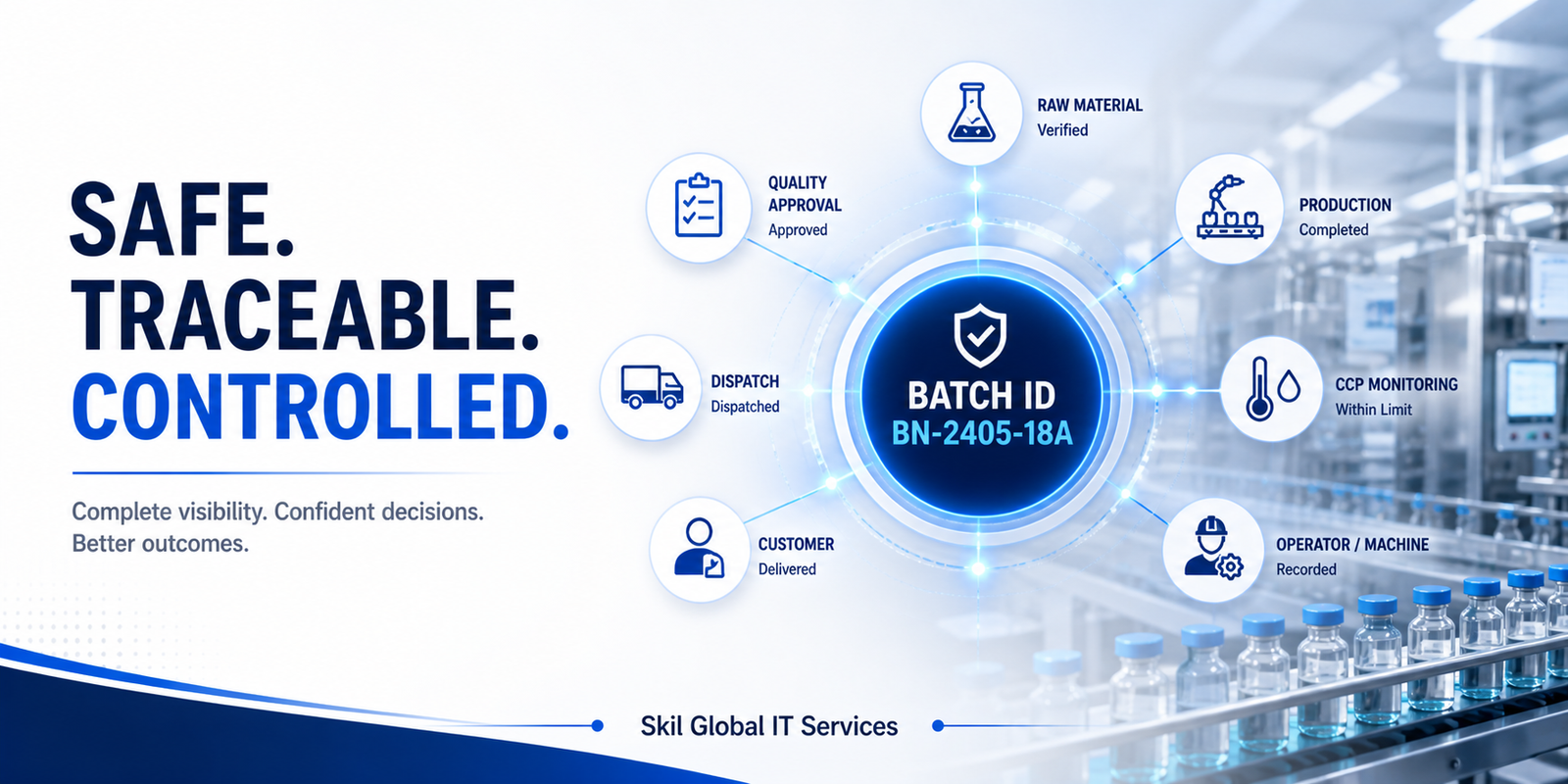
The Illusion of Compliance
Most food companies operate under a dangerous assumption: they believe that because they have SOPs, checklists, and a history of passing audits, they are “compliant.” However, there is a massive gap between being Audit-Ready and being Crisis-Ready.
On paper, everything looks fine. But the moment a contamination issue surfaces or a regulatory inspector asks for a deep-dive, the cracks appear. A simple question—“Can we prove exactly what happened to this batch at 3:00 AM on a Tuesday?”—usually triggers a multi-departmental scramble. If your compliance relies on pulling physical files and cross-referencing manual logs, you don’t have control. You just have a very expensive paper trail.

Download the ERPNext Brochure
See how SKIL Global helps manufacturing and pharma plants plan, implement, and sustain ERPNext.
The Reality: Fragmentation is Your Biggest Risk
Food safety frameworks like HACCP and FSSAI are straightforward in theory, but execution is where most plants fail. The challenge isn’t a lack of data; it’s that the data is trapped in silos.
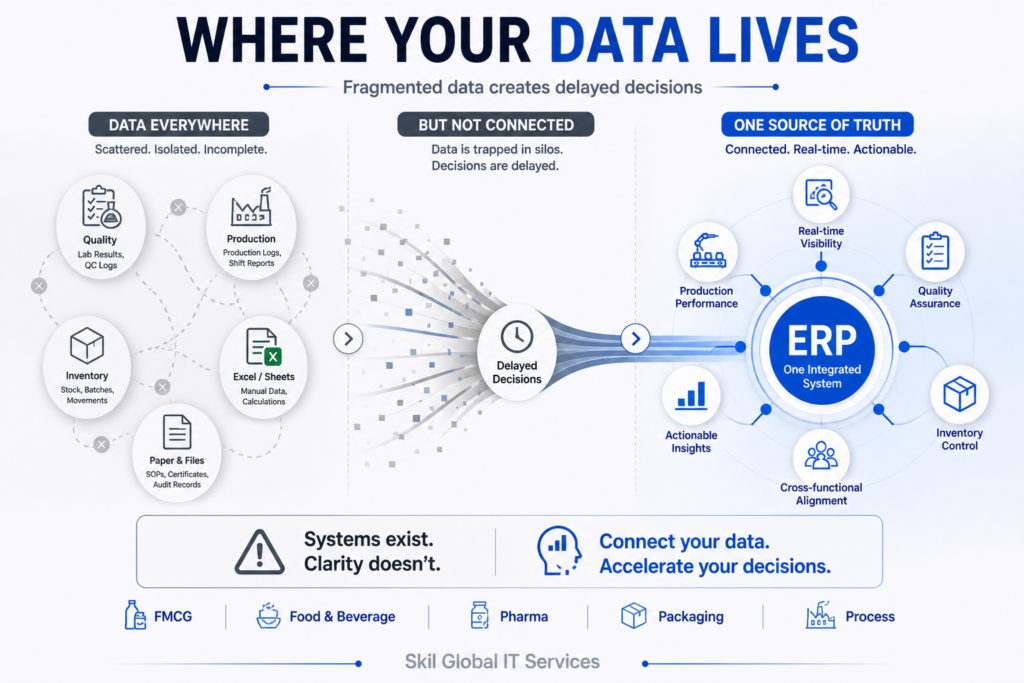
In a typical manufacturing environment, quality parameters live in a lab notebook or an Excel sheet, while production entries and material movements sit in a separate logbook. This fragmentation forces teams to rely on “human effort” rather than “system intelligence.” By the time a deviation is caught in a manual review, the affected product might already be on a delivery truck. In food manufacturing, that delay isn’t just an inefficiency—it’s a massive legal and financial risk.
The Shift: Documentation-Driven vs. System-Driven Compliance
To achieve true safety, you have to move away from Documentation-Driven Compliance. This is the old way: you record data, file it away, and pray you don’t have to find it until the next audit. It’s a passive approach that only tells you what went wrong after the fact.
The alternative is System-Driven Compliance. Here, safety isn’t an extra step; it’s a byproduct of the process. Modern ERP platforms like ERPNext allow you to bake HACCP and FSSAI requirements directly into your shop-floor workflows. Compliance becomes “invisible” because the system simply won’t allow a non-compliant action to take place.
The Deep Dive: Building a Digital Safety Backbone
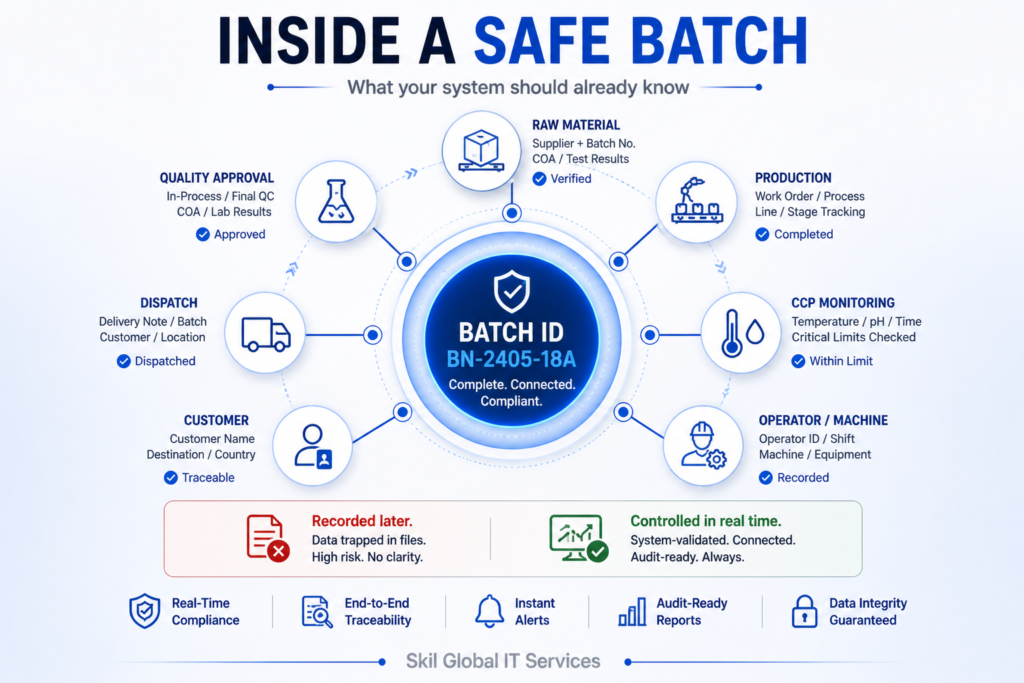
When you structure your food safety through an integrated ERP, the system acts as a 24/7 digital supervisor. It starts at the gate: every raw material is linked to a supplier batch, an expiry date, and mandatory quality parameters.
Critical Control Points (CCPs) are no longer just marks on a clipboard. They become hard-stops in the system:
- Mandatory Validations: The system can prevent a work order from moving to the next stage if a temperature or pH check wasn’t logged within the safe threshold.
- Real-Time Traceability: You get an automated “genealogy” for every batch. With one click, you can see the supplier’s COA (Certificate of Analysis), the operator who handled the processing, and the final dispatch destination.
- Automated Reconciliation: The system handles the “Upstream and Downstream” math for you, ensuring that material usage matches output—a critical requirement for FSSAI audits.
If a recall or a quality deviation occurs, you aren’t “reconstructing” history. You are simply accessing it. No guesswork, no frantic phone calls, just instant clarity.
The Reality Check: From “Preparing for Audits” to “Always Ready”
We recently worked with a high-variation food manufacturer that struggled with inconsistent quality records and a grueling 3-day preparation period before every audit. Despite following their SOPs, they lacked data integrity.
After moving to an integrated ERP structure, the change was immediate. Quality checks were embedded into the production flow, and batch tracking became a background process. The result? Audit preparation time didn’t just drop—it effectively disappeared. The team stopped “preparing” for audits because the system ensured they were always in compliance. They moved from a culture of reporting what happened to a system that controls what is happening.
The Bottom Line
HACCP and FSSAI compliance cannot be sustained through human willpower and paper logs alone. It requires a connected foundation where data is validated in real-time and records are generated automatically.
Modern platforms provide the tools, but the real value lies in the implementation—ensuring the system reflects your actual floor practices and the high stakes of food safety. In the end, the goal isn’t just to pass an inspection. It’s to be able to answer one question with absolute confidence: “Is our product safe—and can we prove it right now?”
Final Thought: If your team still spends days “cleaning up records” before an auditor arrives, you don’t have a safety system. You have a storytelling process. In this industry, that’s a liability you can’t afford.