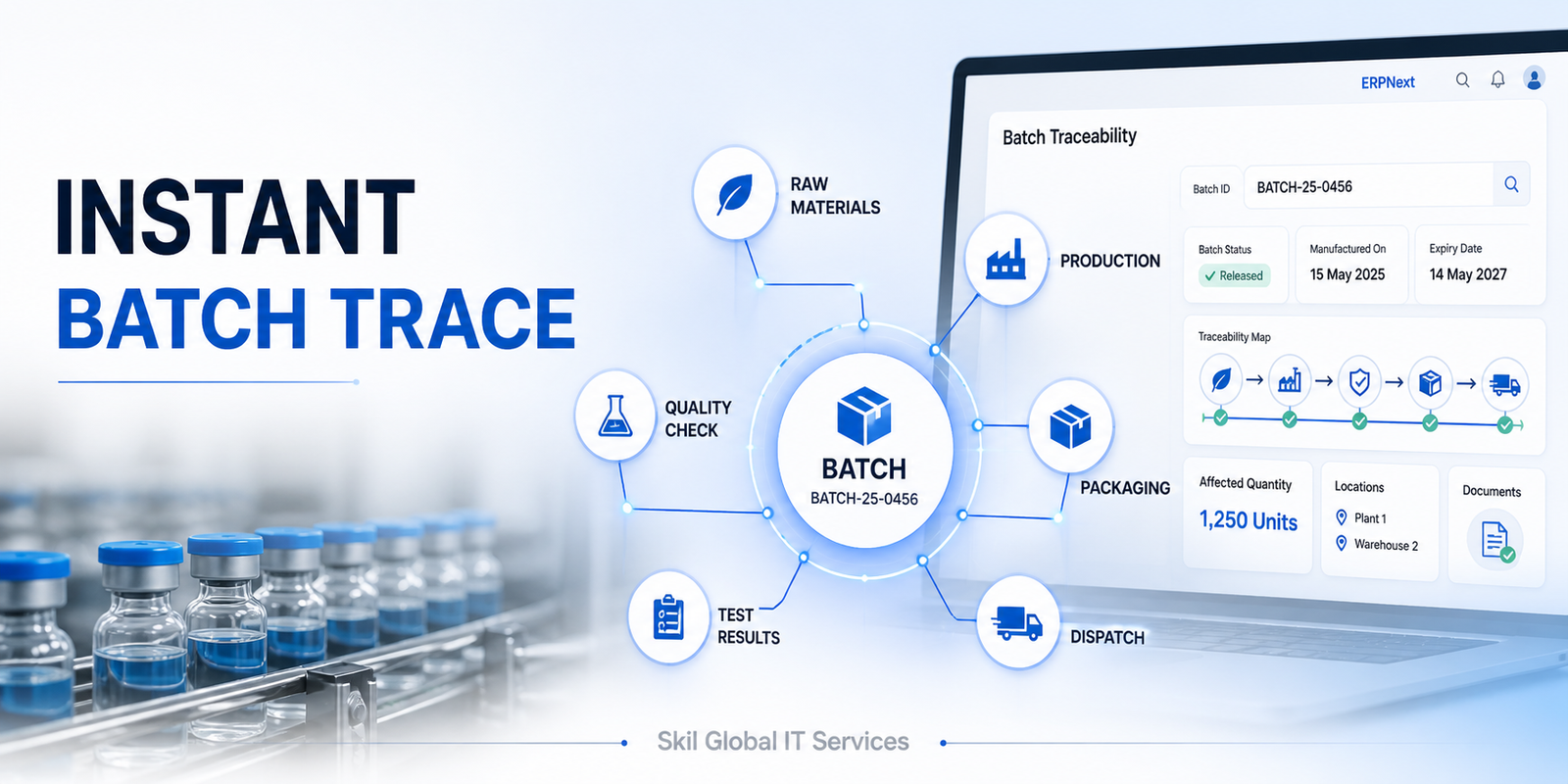
Most pharma companies don’t struggle with compliance. They struggle with clarity. On paper, everything looks right. Batches are recorded. Audit trails exist. Systems are validated. But when something actually goes wrong—a deviation, a failed batch, or worse, a recall—the situation changes.
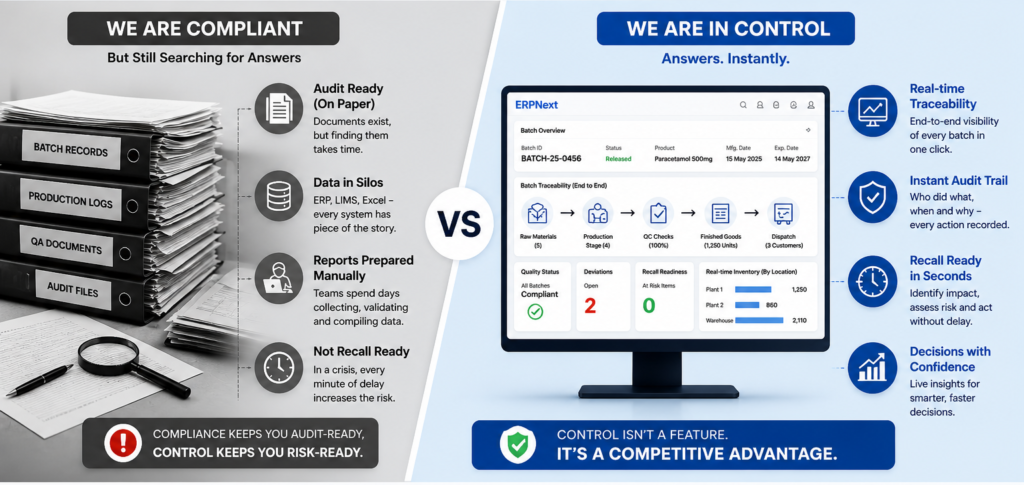
A simple question like “Where did this batch go?” turns into a multi-day effort. Teams pull data from different systems, QA checks logs, production verifies entries, and suddenly a “controlled” environment starts feeling chaotic.
That’s the uncomfortable truth:
You may be compliant—but you’re not in control. And in pharma, that gap is where risk lives.
The Reality Check (The Problem Phase)
Most companies already have systems like ERP, LIMS, and quality tools. But they don’t work as one.
Batch data sits in pieces: Production in one system, Quality records in another, Inventory somewhere else.
The ERP captures transactions, but it doesn’t connect with them in a way that answers real questions. So, when an audit happens or a deviation needs investigation, teams don’t rely on the system—they rely on effort.
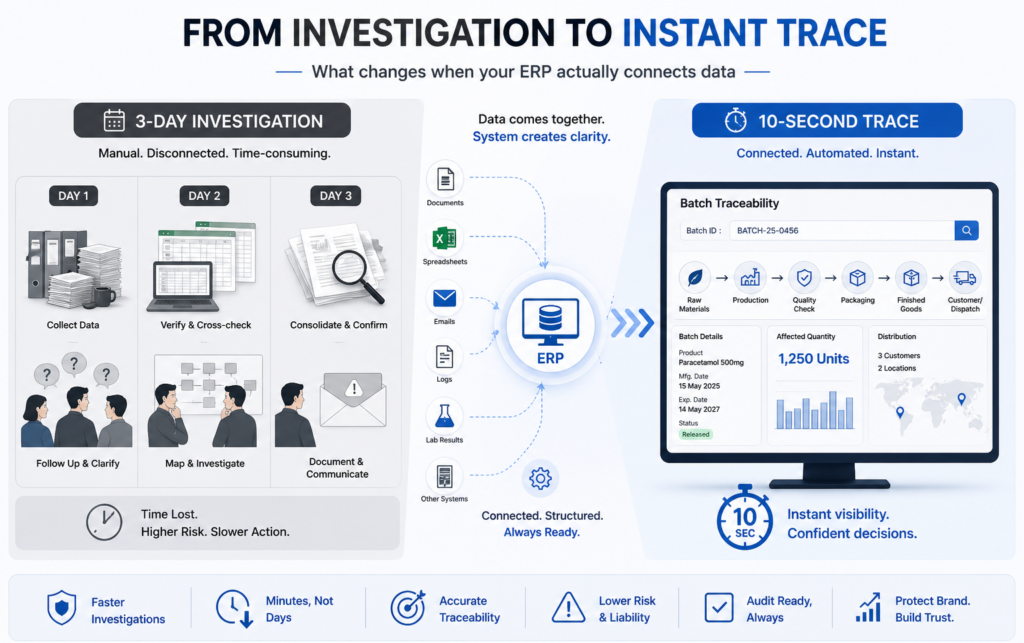
This is a common pattern. Data exists everywhere, but it doesn’t translate into usable insight. Teams spend time preparing reports instead of acting on them, and decisions are still driven by experience rather than system visibility. And that’s where traceability breaks down. Because in pharma, traceability is not just about finding a batch.
It’s about proving: Who touched it, What happened to it, When it happened
The Mental Model (The Conceptual Phase)
It helps to rethink what an ERP is supposed to do. Most systems today behave like record keepers. They store information, but they don’t guide action. They tell you what happened, but not what it means. A modern ERP, on the other hand, behaves like a control system.
It connects: Inventory, Manufacturing, Quality into a single flow of information. This is where platforms like ERPNext stand out.
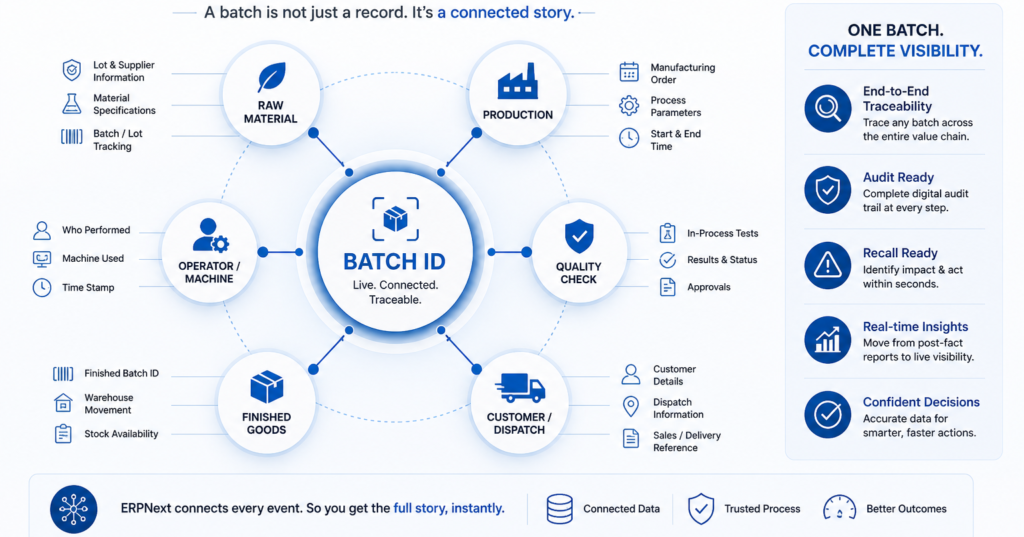
Instead of treating traceability as a report, the system builds it into the process itself. Every transaction is linked. Every movement has context.
Download the ERPNext Brochure
See how SKIL Global helps manufacturing and pharma plants plan, implement, and sustain ERPNext.
The Deep Dive (The “Meat” Phase)
In a properly designed ERP environment, batch traceability doesn’t feel like extra work—it feels invisible. It starts with batch-controlled inventory, where every material is tracked from the moment it enters the system. As production begins, this data flows into manufacturing orders and becomes part of the process automatically. This is where Electronic Batch Records (EBR) come into play.
Instead of paper-based documentation, every step is captured digitally: Material consumption, Process stages, Operator actions, Quality checks and approvals. Each action is time-stamped, linked, and validated. What you get is not just traceability—but a complete audit trail. Not something you prepare later, but something that already exists.
At any point, the system can show:
- The full genealogy of a batch
- Its movement across stages
- Its linkage to customers and dispatch
This enables something critical in pharma: Recall readiness. Because when a recall situation arises, you’re not reconstructing data. You’re simply accessing it. And increasingly, companies are moving toward real-time reconciliation—where batch-level visibility is not post-production, but available during the process itself.
The Proof of Concept (The Case Study Phase)
We implemented this approach for a high-complexity manufacturing environment where, much like pharma, the margin for error was zero. The business had: Highly variable product structures, Complex BOMs, Strong dependency on manual validation.
Despite having systems in place, they lacked clarity. Costing, production data, and decision-making were disconnected. Every critical decision depended on individual experience rather than system intelligence. Once ERPNext was implemented, the shift was structural. BOMs were standardized. Transactions were connected. Every order carried real-time visibility—not just into cost, but into how it was built.
What changed wasn’t just reporting. It was confidence. Decisions became system-driven. Errors reduced. Dependency on individuals dropped.
And importantly: The same structure that enabled costing clarity also enabled full traceability.
Because both rely on one thing—connected, validated data across the system.
The Safety Net (The Reassurance Phase)
Batch traceability is often treated as a compliance requirement—something you prepare for audits or inspections. But in reality, it’s a reflection of how well your systems are designed. If your ERP is fragmented, traceability will always feel slow, manual, and stressful. If your ERP is built as a connected control system, traceability becomes natural.
Modern ERP platforms like ERPNext are designed with this in mind:
- Integrated data across functions
- Built-in audit trails
- Scalable and flexible architecture
- Support for validated, digital processes
But the real value doesn’t come from the software alone. It comes from how it is implemented—how well it reflects your actual processes, your compliance needs, and your operational reality.
Final Thought
If tracing a batch still takes hours in your system, you’re not dealing with a process problem. You’re looking at system limitations. And in pharma, that’s not just inefficient. It’s a risk.
Question:
Can your team trace any batch—end to end—in under 60 seconds?
If not, where does the delay actually come from: The process… or the system?
Frequently Asked Questions
Compliance means you are recording data and validating systems on paper to pass audits. Control means you have instant, real-time clarity. If a batch fails, a compliant company may take days pulling records from fragmented systems (ERP, LIMS, and paper logs) to find out what happened, while a company in control can trace the exact genealogy, operator, and timeline of that batch in under 60 seconds.
Traditional ERPs act as passive record keepers—they store data after production is already finished, telling you what went wrong when it is too late. A modern control system, like ERPNext, builds traceability directly into the daily workflow. By integrating inventory, manufacturing, and quality into a single flow, it utilizes Electronic Batch Records (EBR) to time-stamp and validate every single operator action, material consumption, and quality check in real time.
When data sits in disconnected pieces, teams are forced to rely on manual human effort rather than system intelligence during a crisis or deviation. This data fragmentation makes recall readiness slow and stressful. In pharma, a breakdown in instant traceability creates a massive visibility gap, turning unexpected regulatory checks or batch failures into high-stakes operational and financial risks.